2B (January - April 2018)
Disappointment, despair, and determination.
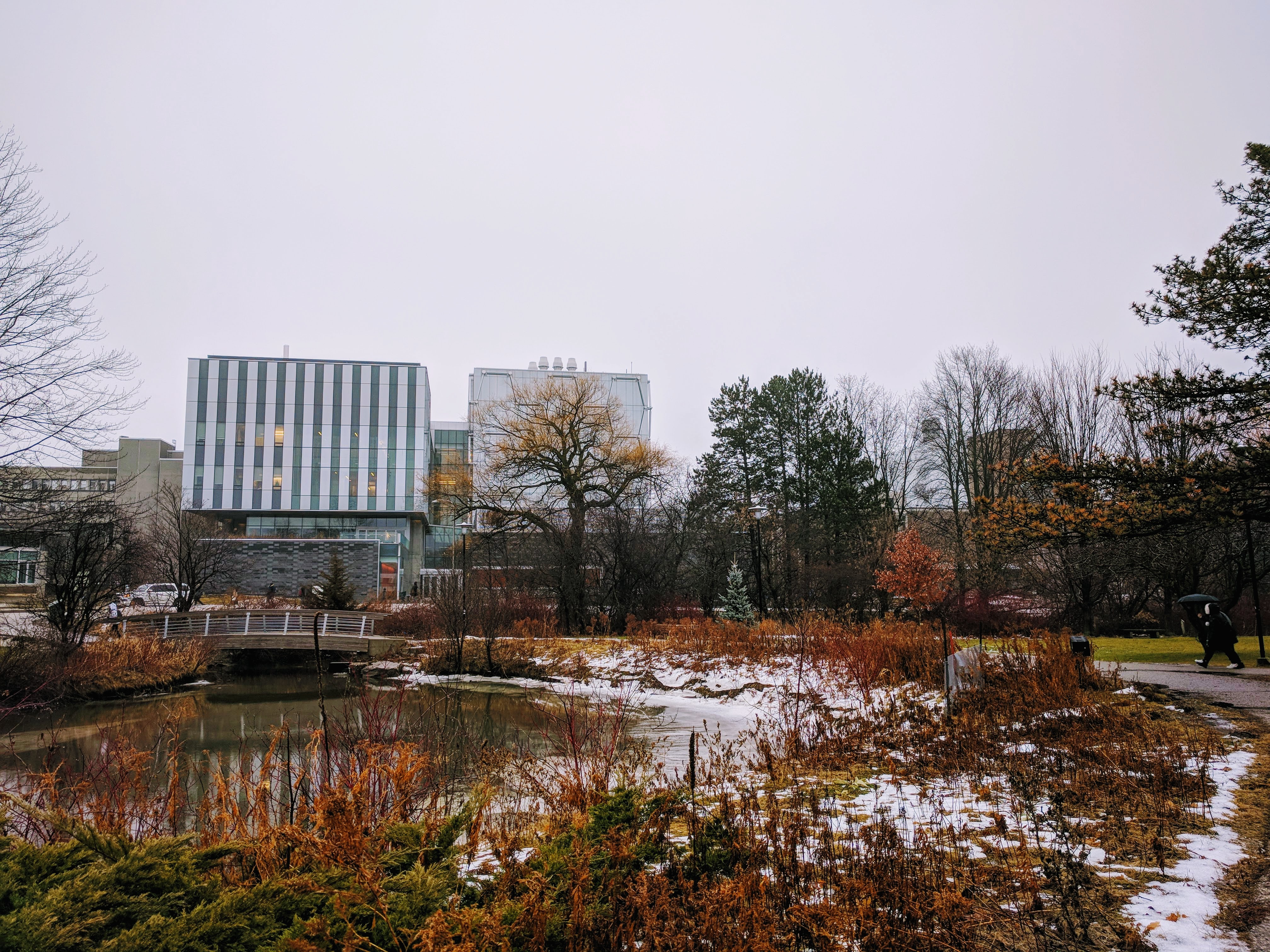
Every story has its lowest point and for me, this probably occurs within 2B. You may recall the hanging thread from the 1B chapter regarding track and field. Although my running shortcomings in first year were unfortunate, it was hard be too upset. First year is such a transitory year in many aspects and it’s almost expected for freshman to “underperform” (and truthfully speaking, based off how good of a runner I was coming into university, I would hardly say that I underperformed). That said, the pain of missing out on a season of team bus rides, carpools to practice, pre meet pasta dinners, and all the in between moments that come with the varsity student-athlete experience still hung in the forefront of my conscience throughout all of second year.
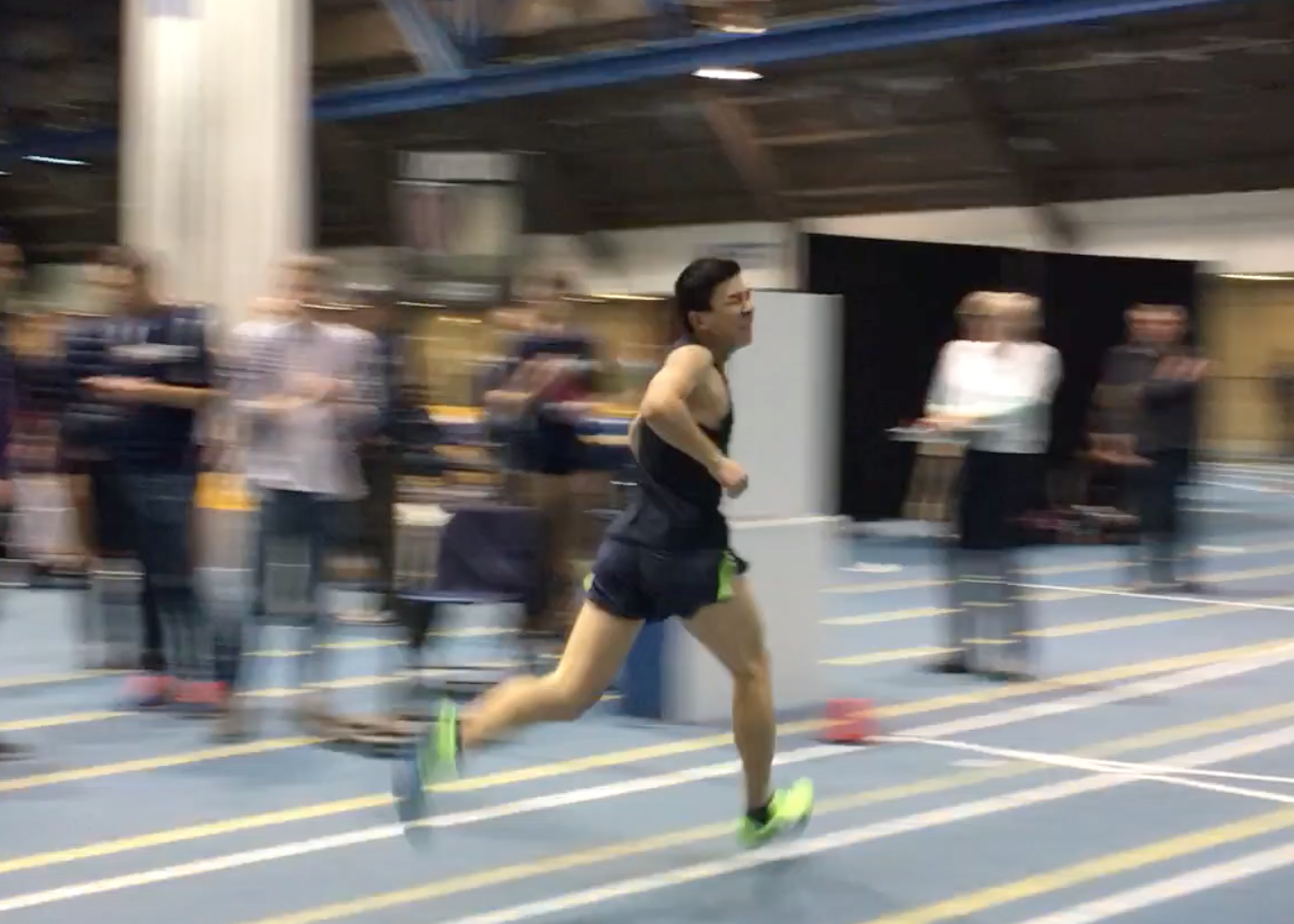
In the year that followed, I worked hard to make sure that the outcome would be different in second year. The fall of 2A looked promising, as I shifted focus away from cross country into more specific workouts that would help me for the speedier needs of track. We also had a specific group of middle distance runners (which I am) which was great in helping everyone work out harder and have more fun while doing so. Easy jogs became opportunities to daydream about the race where I would get redemption and run the team standard. That day came promptly one week into 2B. However, as fate would have it, I would end up missing the standard again - by an agonising 0.22 seconds.
One of the things I love most about the sport of track and field is how cut and dry it is. There is little room for ambiguity or excuses. Yes, there are external factors, but at the end of the day, the time on the clock is what you ran and ultimately, you have to take ownership of that. That extreme bluntness is something I appreciate and think helps nurture my overall character. However, on days such as January 6th, 2018, it can also break you. I sat quietly by myself on the team bus back from that meet, forced to overhear other athletes excitedly talk about the season ahead, a season where I knew I would yet again be on the sidelines, it felt like a cruel final stab.
As the bus rolled back into campus, the coaches stood up at the front of the bus and gave a wide sweeping general congratulations and also mentioned notes about the upcoming team meeting, further emphasising my failure of the day. By the time the bus came to a standstill, I dashed off, I couldn’t be in that bus for another second. It was a cold snowy winter night and my foot immediately sunk past the ankle in the fresh snow on the sidewalk. I didn’t have my car on campus and I lived far enough away that it probably made sense to ask for a ride but I felt sick to my stomach hanging around any further and set off on a miserable 30 minute walk home by which my socks were completely soaked by the time I got back.
For better or for worse, at this point in my life, outside of running, I would say that I had never quite failed. I of course had moments where I didn’t get what I wanted but by and large, things tended to miraciously work out in the way I wished. I got into my #1 pick university, had never failed a course nor had any significant personal rejection. This “fortune” may sound nice but it eventually ends and that first failure cuts deep.
Thankfully, I had incredible support from my older brother to get me back on my feet. My brother is also a runner, more specifically, a runner on the Waterloo track team eight years prior. He coached me through high school and was a major reason why I started running in the first place, continuing to be there every step along the way in my running career. When I entered university, there would often be extended periods with little to no coaching from the school coach and in these times, my brother would once again step in. He was the first person I’d call after a race, a mentor, a workout partner, and my #1 fan. About a week after the race (I had not run a step since, recklessly texting him on the bus ride back that I was “done with running”), he sent me an email called “On running inadequacy”. Here is a slightly edited version of it:
Hi Nick,
I’m sure that Saturday’s race result was DEVASTATING.
I absolutely will not fault you if you decide to not race competitively anymore. I can sympathize that the last 1.5 years of running have been without the progress we both thought would happen. And the main thought is that continuing to run all these workouts alone seems extremely foolhardy and pointless without seeing desired results. One thinks of the opportunity cost of the time, and especially at your age there are so many possibilities that one could take advantage of.
The thing I may never have told you about running is that it often brings a feeling of inadequacy. The surprising thing is that this feeling will never really go away (unless you are Rudisha). There will always be rivals that improve faster than you, key barriers that aren’t broken (sub 2, sub 1:50, sub 1:45), and races that are failures.
At the end of 2nd year (just a few months ahead of where you are now), I really questioned whether I should run at all anymore. Coinciding with Terry’s (the former UW distance coach) death, it was just a few months before the outdoor season started and I had only run 1:28.x during the indoor season - a time that several guys can split enroute their 1K races.
[…]
The truth is that feeling like a completely shitty runner is the most crucial step to getting faster. I’ll describe the results of the bullets above:
During the summer after 2nd year I thought, “There are guys that can run under 4 minutes for a mile. If they can do that, I should be able to run half of that. In fact, I believe I can do it”. I read up on Roger Bannister’s old-school mile training and spent many days running an arch on the road that was around 400m in 60s over and over again. I ran 2:00.3h that season.
During 3rd year, I decided that the sprinters kept beating me since they were ahead going into the bell lap. I thought it about it more and realized that I was letting this positioning occur since I lacked confidence in my speed vs the sprinters for the first lap. What changed everything before OUAs was that I pondered it over and came to believe in my ability to handle lactic pain more. I decided I would make sure I was ahead at 400m even if I had to PB to do it. I ran 1:24.1 to finish 2nd in the heat by two strides.
My first race of the season happened to be a well-attended race against several collegiate runners that had faster PBs than me. They were still part of university teams with large training groups and probably spent hours with supplementary exercises/physiotherapy. In contrast from Jan to April, I left to work downtown at 8am, returning to York at 6pm. Then I would run around the neighborhood for 30min, buy food, and attend my 7pm three hour lecture in my running clothes. I came to view this terrible schedule as a strength and when I lined up on the start-line, I believed that I was mentally tougher than my competitors. I ended up beating a ton of them and a 1 second PB with 1:55.9.
The story continues.
The main path to improvement I’ve observed in athletics comes from getting DEVASTATED, gradually gaining physical confidence, and then having a breakthrough sense of belief.
You will recall that I asked why you didn’t go with the leaders through the first lap of the 600m on Saturday. You responded that Owen would likely split through too fast, which would be unoptimal. And you were right. It would indeed be stupid to sprint in 25s for the first 200m, effectively killing the rest of the race. However, what I was trying to convey was a sense of “reckless abandon”. To make large improvements, it’s beneficial to be bravely stupid. Against a field with people within 2 seconds of your PB/goal time, you must believe you can win to push your limits.
“Sure splitting 25s is stupid, but you would still be like four strides down from the leader. And if you’re being stupid with a 25, he must be even stupider! Surely, you’ll have the advantage in winning the race if you at least maintain contact amirite?” To contend for the win means you are willing to jump off a cliff if your competitor does, just be slightly safer.
I cannot promise you that this mental strategy will work and there certainly is a chance you will just crash and burn. But the only way to find out is to try.
If you really think that running/track is not worth the time and effort at this point, you are probably right.
But if you think just hitting the time of sub 1:27 or sub 2 in the 800 outdoors this summer would make it worthwhile, then I definitely think you should stick at it.
The belief in purpose is sufficient to make purpose real.
Let me know what you decide and I’ll send you the workouts I ran to get to 2 flat if you decide to continue. Your workouts indicate 1:26 is in the cards already.
Reading this email back years later still moves me. Much of the points he makes about the process of improvement, reckless abandon, and the belief in meaning I have come to view as applicable far beyond the context of running in laps. After receiving this email, I was reinvigorated to give track one more chance and in the month that followed, my life consisted of nights alone at the track ripping laps until I was seeing stars and tasting lactic acid. I’d text my brother between reps and on days when there was a university track meet that I was missing, I’d leave the live stream/results up on my laptop by the finish line, reminding me what I was seeking. In retrospect, this month of intense solitary training was probably not “healthy” but it was a period of character building that made me the person that I am today.
At the end of this month, I was ready to give it one more go and I entered an open track meet in Toronto. With my brother there in person, I ran with my head high, fearless and proud of what it had taken to get back to the start line. Though the university season was nearly at its end and the school coach would probably not even see the result, this race meant everything to me. I ended up running 1:27.6, a breakthrough performance, good for team standard, and a validation of everything my brother wrote to me in that email. Feeling completely shitty is indeed the most crucial step in becoming better.
On the school side of things, things actually flourished in tandem with my intensely self motivated running journey. After the debacle with CS246E in the previous semester, I decided to drop down from the advanced sections for everything except statistics and the pressure of school immediately eased up. This semester’s grade average ended up being by far the highest of my entire university career. I established a very consistent weekly routine that enabled me to finish assignments well in advance of the due dates, a first (and only) since I had started university. The courses I was taking also actually became fun and assignments started to feel like fun puzzles to figure out instead of anxiety-inducing mountains to climb.
Despite all of these positive changes, school also became a lot lonelier this term. In 1A, a study group within the advanced math class was formed with people coming and going throughout the semesters but a solid core of five people remaining throughout. Some of my best memories from first and second year are the countless nights we’d spend in the basement of STC (Science Teaching Complex) doing assignments together and also taking a few too many breaks to get food from iNews or play flash web games. Staying until 3am or 4am was not uncommon and there was one instance where we rotated taking naps in a separate room and waking each other up.
In the Math faculty, as the semesters pass, the number of compulsory courses reduces and there is a lot more choice over the direction your degree goes (a huge reason why I didn’t do engineering). Since we actually had differing majors (though all under the umbrella of Math), by 2B, it became harder to coordinate more classes together. At this point, the only thing we had left together was advanced statistics (the main reason why I stayed in advanced). The absence of the study group in my other classes was immediately felt and I was now struggling to recognize a single face in many classes.
Pairing this with my solitary running mission put me in a routine and headspace of being quite closed off. I would spend far too many weekends out of Waterloo and would go to campus just for class and leave right after. Looking back, I kick myself for this but this is how lessons are learned and I look back on this period of self isolation as an important low point in my university journey.
I wasn’t sure where to fit this last bit about 2B above but I think that separated characteristic is a defining component. MUSIC255 was probably my favourite class I took in all of university and thinking back, the fact that it occurred in 2B feels so odd. It existed in a vacuum away from all the other developments with running, school, and everything else. The course, titled “The Romantic Century: Beethoven and Beyond”, was a music history course covering roughly 1775-1900, a densely packed period of artistic development. When a class aligns tightly with your own personal interests, it really doesn’t feel like school and I probably retained the most information from this class out of everything I took in university.
The instructor, Kenneth Hull, was fantastic and the class had an added weight when it was revealed that this would actually be his last course before retiring. The very last day of lectures was a presentation day and my presentation on Edward Elgar’s Enigma Variations was the last to go. The presentation went very well and promptly afterwards, the entire music faculty came in with a cake and we all sang Professor Hull “For He’s a Jolly Good Fellow” to mark the retirement of a fruitful career. It makes me feel good that I was a part of his very last lecture, he was a wonderful professor to have. It was a very sweet moment.
Scattered memories:
- STAT241 Assignments at Thomas’
- Movie nights at Princess
- MATH249 coming in clutch during interview w/ OpenText
- School being easy for the first time ever, finishing an entire week of work in an evening
- Fortnite live streams while doing homework
- The saga of our interesting watery downstairs sublet
- Suzuki 45th Anniversary
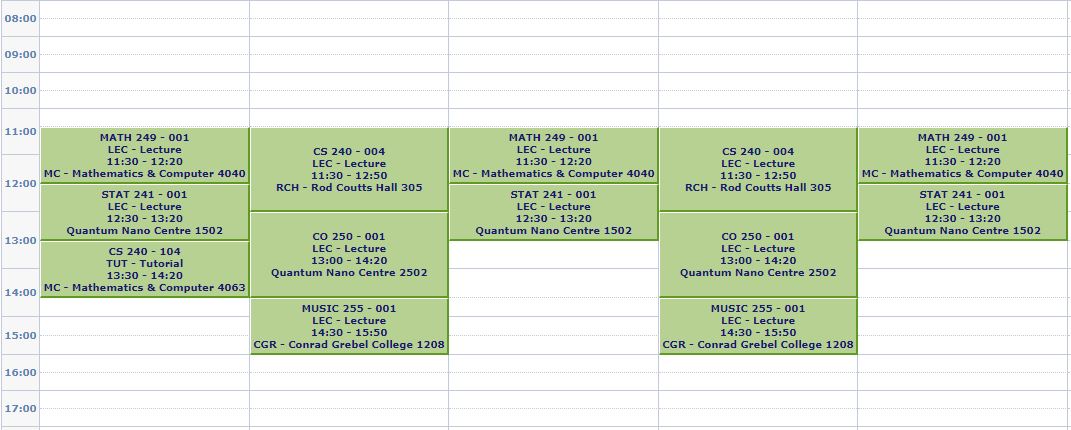
Classes took:
- MATH239 w/ Michele Mosca
- CO250 w/ Laura Sanita
- She had a lovely accent and I’ll always be able to hear her saying “simplex algorithm”
- CS240 w/ Sebastian Wild
- STAT241 w/ Mu Zhu
- Had the most wild grading scheme I’ve ever seen, 100% on final exam -> 100% in the course no matter what
- MUSIC255 w/ Kenneth Hull
Songs:
- For My People - Sami Elu
- Whatever the composer of the week was in MUSIC255 honestly